


Summary
本期摘要
新規速遞:《最高人民法院關于審理勞動爭議案件適用法律問題的解釋(二)》發布
Snapshot of New Regulations: The Interpretation of the Supreme People’s Court on the Application of Law in the Trial of Labor Dispute Cases (II) was Released
新規速遞:人社部發布《超齡勞動者基本權益保障暫行規定(公開征求意見稿)》;人社部辦公廳發布《企業實施競業限制合規指引》
Snapshot of New Regulations: The Ministry of Human Resources and Social Security (“MOHRSS”) Released the Interim Provisions on the Protection of Basic Rights and Interests of Over-Age Employees (Public Exposure Draft); The General Office of the MOHRSS Issued the "Compliance Guidelines on the Implementation of Non-Competition Restrictions by Enterprises"
新規速遞:北京、上海、天津陸續調整最低工資標準
Snapshot of New Regulations: Beijing, Shanghai, Tianjin Adjust Minimum Wage Standards
典型案例:人民法院案例庫新增2件勞動爭議案例
Exploration of Typical Cases: 2 New Labor Dispute Cases Added to the People's Court Case Database
典型案例:北京市、重慶市發布競業限制相關案例
Exploration of Typical Cases: Beijing and Chongqing Released Cases Related to Non-compete Restrictions
一、新規速遞:《最高人民法院關于審理勞動爭議案件適用法律問題的解釋(二)》發布
2025年7月31日,《最高人民法院關于審理勞動爭議案件適用法律問題的解釋(二)》(法釋〔2025〕12號,“《司法解釋二》”)發布,并于2025年9月1日起正式施行。作為勞動法領域的重要司法依據,《司法解釋二》歷經長期和廣泛的征求意見過程后,終于正式落地。
On July 31, 2025, the Interpretation of the Supreme People’s Court on the Application of Law in the Trial of Labor Dispute Cases (II) (法釋〔2025〕12號, “ the Judicial Interpretation (II) ”) was released, and officially came into effect on September 1, 2025. As an important judicial reference in the labor law field, the Judicial Interpretation (II) was formally enacted following an extensive and prolonged process of public consultation.
相較于《最高人民法院關于審理勞動爭議案件適用法律問題的解釋(二)(征求意見稿)》(“《征求意見稿》”)的27條,《司法解釋二》最終確定為21條,刪除了《征求意見稿》中關于股權激勵案件定性、未休年休假補償時效等爭議性較大的條款;對其余條款進行形式或實質性調整,對于競業限制無效情形、混同用工的責任劃分、勞動合同不能繼續履行的情形、社保免繳約定的后果、二次固定期限合同認定等難點問題明確了裁審口徑。
Compared to the 27 articles in Interpretation of the Supreme People’s Court on the Application of Law in the Trial of Labor Dispute Cases (II) (Exposure Draft) (the “Exposure Draft”) , the finalized Judicial Interpretation (II) has been streamlined to 21 articles, which removed several controversial provisions such as those concerning the nature of equity incentive cases and the statute of limitations for compensation for unused annual leave from the Exposure Draft. The remaining provisions have undergone formal or substantive revisions in the Judicial Interpretation (II) which clarifies on challenging issues including the circumstances where non-compete agreements are deemed invalid, liability allocation in cases of mixed employment, situations where labor contracts cannot continue to be performed, consequences of agreements to exempt the employer from contribution of social security, and the recognition of a second fixed-term contract.
與此同時,最高院一同發布了與《司法解釋二》配套的6個勞動爭議典型案例,涵蓋企業混同用工、競業限制糾紛等熱點問題,直觀詮釋了《司法解釋二》確立的相關規則。《司法解釋二》及典型案例的發布,對統一全國勞動爭議案件的裁判尺度、明晰法律適用規則具有重要的指導意義。
In the meanwhile, six typical cases concerning labor disputes were released together by the Supreme People's Court (“SPC”) as supporting references for the Judicial Interpretation (II), which covers wisely heated-discussed questions such as mixed employment and disputes over non-compete agreements, providing concrete illustrations of the relevant rules established in the Judicial Interpretation (II). The release of both Judicial Interpretation (II) and the typical cases is considered to be of significant guidance for unifying the adjudication standards of labor dispute cases nationwide and clarifying the application of legal principles.
我們近期從相關背景以及引申與提示等角度對《司法解釋二》進行了逐條解讀,具體內容請參見《海問·觀察︱勞動爭議《司法解釋二》分析解讀(第1-10條)》和《海問·觀察︱勞動爭議《司法解釋二》分析解讀(第11-21條)》。
Recently, we have conducted a clause-by-clause interpretation of the Judicial Interpretation (II) from perspectives including its relevant background, implications, and practical insights. For more detailed information, please refer to: "Haiwen Observations: Analysis of the Judicial Interpretation (II) on Labor Disputes (Articles 1–10)" and " Haiwen Observations: Analysis of the Judicial Interpretation (II)on Labor Disputes (Articles 11–21)".
二、新規速遞:人社部發布《超齡勞動者基本權益保障暫行規定(公開征求意見稿)》;人社部辦公廳發布《企業實施競業限制合規指引》
The Ministry of Human Resources and Social Security (“MOHRSS”) Released the Interim Provisions on the Protection of Basic Rights and Interests of Over-Age Employees (Public Exposure Draft)
2025年7月31日,人力資源社會保障部(“人社部”)發布《超齡勞動者基本權益保障暫行規定(公開征求意見稿)》(“《公開征求意見稿》”)向社會征求意見。此舉旨在應對人口老齡化趨勢,減少勞資雙方的爭議,保障超齡勞動者的合法權益。該規定在權益配置上特點鮮明,具體而言:
On July 31, 2025, the Ministry of Human Resources and Social Security (“MOHRSS”) released the Interim Provisions on the Protection of Basic Rights and Interests of Over-Age Employees (Public Exposure Draft) (the “Public Exposure Draft”) to seek public opinion, which aims to address the trend of populating aging, reduce labor disputes, as well as safeguard the lawful rights and interests of over-age employees. The Public Exposure Draft is distinctive in its equity allocation. Specifically:
(1)《公開征求意見稿》明確了適用對象的范圍。對于超過法定退休年齡的勞動者(“超齡勞動者”),無論是否享受養老保險,均納入《公開征求意見稿》的保護范疇中。
The Public Exposure Draft clarifies the scope of application. Employees who have exceeded the statutory retirement age (“over-age employees”), irrespective of their eligibility for or receipt of pension insurance benefits, are included within the protective scope of the Public Exposure Draft.
(2)《公開征求意見稿》切實考慮超齡勞動者的基本權益和企業用工成本。規定了用人單位應當合理安排超齡勞動者的工作時間和休息休假、提供不低于最低工資標準支付工資報酬、按照國家規定為超齡勞動者參加工傷保險并繳納工傷保險費等內容。
The Public Exposure Draft are designed to protect the basic rights of over-age employees while giving due consideration to the labor costs incurred by enterprises. It set out that employers shall reasonably arrange working hours and rest for over-age employees, as well as provide remuneration not lower than the minimum wage standard, and participate in work-related injury insurance and contribute work-related injury insurance for them in accordance with national provisions.
(3)《公開征求意見稿》體現了自愿性、協商性的原則。明確提出超齡勞動者和用人單位可以根據合法、公平、平等自愿、誠實信用的原則,協商一致確定雙方的權利和義務。
The Public Exposure Draft reflects the principles of voluntariness and negotiation.It explicitly states that over-age employees and employers may determine their respective rights and obligations through mutual agreement based on the principles of legality, fairness, equality, voluntariness, and good faith.
總體而言,在現行人力資源社會保障立法的總體格局下,《征求意見稿》對超齡勞動者權益保障進行了具體規則設計,為各地用人單位在處理超齡勞動者用工相關問題方面,提供了實質性的參考與指引。
In a conclusion, under the current overall framework of human resources and social legislation, the Public Exposure Draft specific regulatory designs for protecting the rights and interests of over-age employees, which offers substantive reference and guidance for employers across regions in handling employment-related matters concerning over-age employees.
2. 人社部辦公廳發布《企業實施競業限制合規指引》
The General Office of the MOHRSS Issued the "Compliance Guidelines on the Implementation of Non-Competition Restrictions by Enterprises"
2025年9月4日,人社部辦公廳正式印發《企業實施競業限制合規指引》(人社廳發〔2025〕40號)(“《指引》”),《指引》聚集競業限制制度常見問題,細化了競業限制合規實施的具體要求,一定程度上回應了實踐中諸多長期引發爭議的疑難問題,對于企業實施競業限制具有重要的指導意義。《指引》主要有下述新關注要點:
On September 4, 2025, the General Office of the MOHRSS officially released the Compliance Guidelines on the Implementation of Non-Competition Restrictions by Enterprises ((人社廳發〔2025〕40號,the "Guidelines"). The Guidelines focus on common issues related to the non-competition restriction system, elaborate on detailed compliance requirements for implementing non-compete clauses, response to many controversial and difficult issues in practice to a certain extent, and hold significant guiding importance for enterprises implementing non-compete restrictions. The key points in the Guidelines are as follows:
(1)明確實施競業限制的前提條件
Specify the preconditions for implementing non-compete restrictions
在《勞動合同法》的基礎上,《指引》進一步明確實施競業限制的人員范圍,對于僅掌握行業通用的專業知識和技能的勞動者,工作中接觸到的僅為企業一般經營信息,不屬于負有保密義務的人員。企業與其他負有保密義務的人員約定競業限制義務的,要提前告知理由,說明需要保守的商業秘密的具體內容。
On the basis of the Labor Contract Law, the Guidelines further clarify the scope of personnel subject to non-compete obligations, and employees who only possess generalized industry expertise and have access to routine business information in their work shall not be deemed to bear statutory confidentiality obligations. Where an enterprise proposes to impose non-compete obligations on other employees who do hold confidentiality obligations, it must clearly notify them in advance of the rationale and specify the concrete contents of the trade secrets to be protected.
(2)明確實施競業限制應遵循必要、合理原則
Clarify that the implementation of non-compete obligations must adhere to the principles of necessity and reasonableness
《指引》強調競業限制的必要、合理原則,引導企業可優先采取有效措施管控商業秘密知悉權限、加密商業秘密數據、合理設置脫密期等商業秘密保護措施,實施競業限制應開展必要性評估。
The Guidelines emphasize that non-compete obligations must adhere to the principles of necessity and reasonableness. Enterprises are encouraged to prioritize effective measures to protect the trade secrets such as controlling access to trade secrets, encrypting confidential data, and implementing reasonable declassification periods. Before imposing any non-compete restrictions, a necessity assessment shall be conducted.
(3)明確企業與實施競業限制勞動者應公平合理約定權利義務
Ensure that enterprises and employees subject to non-compete agreements negotiate rights and obligations fairly and reasonably
● 關于經濟補償的支付標準,《指引》第十三條規定,企業支付給勞動者的月經濟補償一般不低于勞動者在勞動合同解除或終止前12個月平均工資的30%,且不低于勞動合同履行地最低工資標準;對于競業限制期限超過1年的,月經濟補償一般不宜低于勞動者在勞動合同解除或終止前12個月平均工資的50%。
As for payment standard of compensation, according to Article 13, the monthly economic compensation shall generally not be less than 30% of the employee's average wage in the 12 months prior to the termination of employment, and shall also not be less than the minimum wage standard of the place where the labor contract is performed; if the non-compete period exceeds one year, the monthly compensation should generally be no less than 50% of the employee's average monthly wage in the 12 months preceding the termination of the labor contract.
● 關于競業限制義務的違約金,《指引》第十四條規定,違約金的數額要根據勞動者泄露商業秘密可能造成的經濟損失、企業支付給勞動者的競業限制經濟補償的數額合理確定,一般不宜超過約定競業限制經濟補償總額的5倍。
As for liquidated damages for violation of non-compete obligations, Article 14 states that the amount shall be reasonably determined based on the potential economic losses resulting from the employee’s disclosure of trade secrets and the amount of economic compensation paid by the enterprise. In practice, the damages typically should not exceed five times the total agreed non-competition economic compensation.
● 關于履行競業限制義務的例外情形。《指引》第十七條規定,企業未及時足額支付經濟補償超過1個月經勞動者提醒后仍未支付的,或超過3個月未支付的,勞動者可以不再履行競業限制義務。
As exceptions to the non-compete obligation, according to Article 17, an employee may cease performance of the non-compete obligation if the employer (a) fails to pay compensation for over one month after the employee has given a reminder, or (b) fails to pay for more than three months.
海問建議:《司法解釋二》、《公開征求意見稿》及《指引》均會影響到企業勞動用工的各個方面,對于企業管理行為提出了更高的要求。企業應當在用工管理的過程中重視上述事項,確保符合最新的法律要求。
Haiwen Suggestions: Judicial Interpretation (II), the Public Exposure Draft, and the Guidelines will all affect all aspects of employment in enterprises, and will impose higher requirements on the management practices of enterprises. Enterprises should pay attention to the matters mentioned in the above provisions in the process of labor management and ensure alignment with the latest legal requirements.
三、新規速遞:北京、上海、天津陸續調整最低工資標準
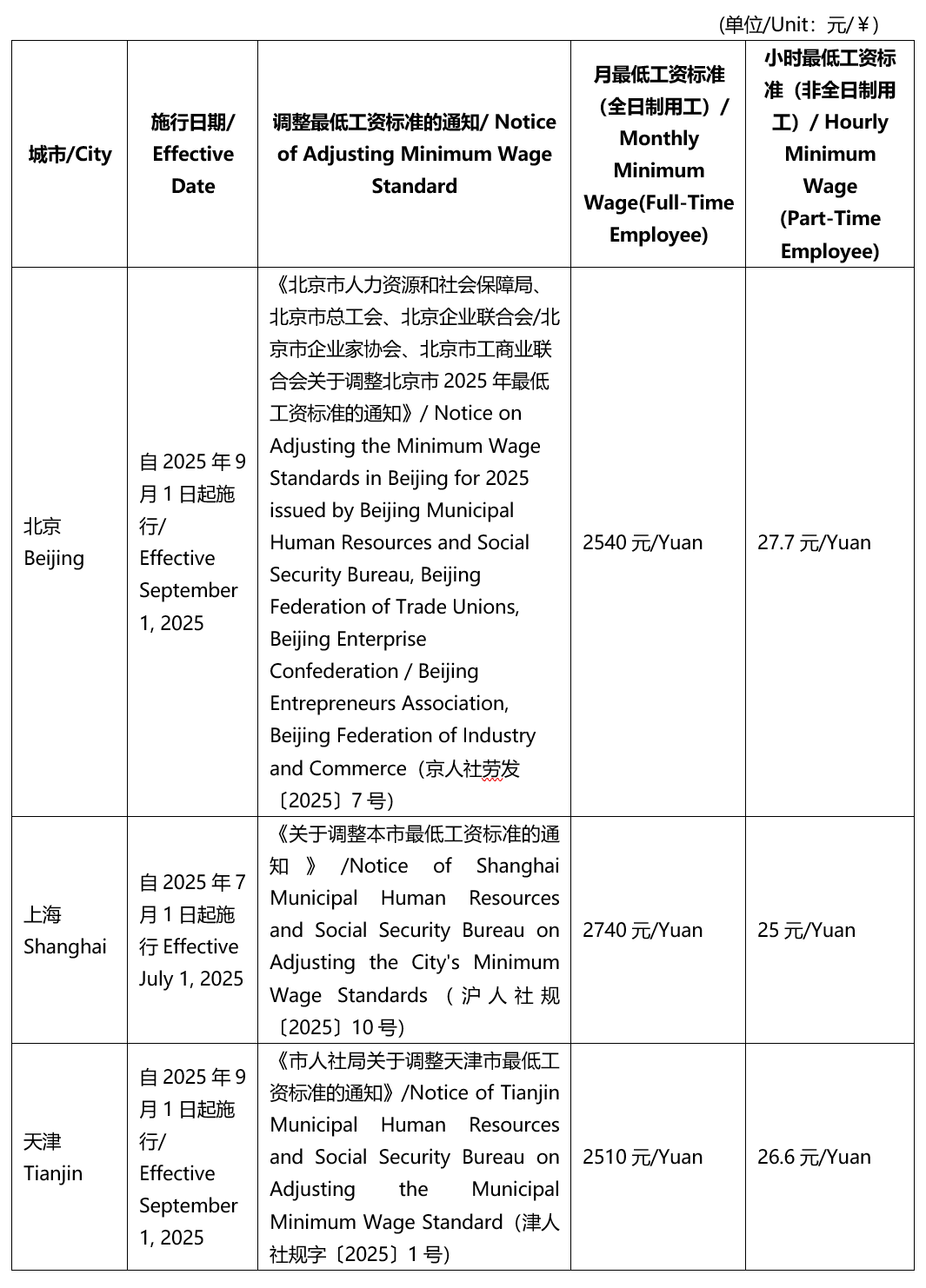
近日,全國多地陸續調整2025年最低工資標準(需注意的是,在存在不同統計口徑的地區,不同使用場景下可能需適用不同口徑的數據,具體應以當地政策為準)。就各地近期出臺的規定,請見我們的總結如下:
Recently, many cities have adjusted the local minimum wage of the year of 2025. (It should be noted that when publishing the wage data, some cities may adopt different approaches which should be applicable to different legal scenarios. Please follow the specific local rules.) Regarding the regulations recently issued by various localities, please see our summary as follows:
四、典型案例:人民法院案例庫新增2件勞動爭議案例
From June to August 2025, the People's Courts Case Database has newly included 2 labor dispute cases, involving issues such as the determination of working hour systems and liabilities related to the termination of labor relations. Up to now, the total number of labor dispute cases included in the database has reached 61, with 1 personnel dispute case. We have summarized the typical judicial views contained in the 2 newly added cases as follows:
1. 在遼寧某商業管理有限公司訴陳某振勞動爭議案中,綜合考慮勞動合同約定為標準工時制、公司未向勞動行政部門辦理不定時工時制的審批手續等事實,法院認定未向勞動行政部門辦理審批手續的“上一休一”特殊工作制,不能當然認定為不定時工作制。在此情形下,對于勞動者加班費數額的認定,應當根據證據體現的加班頻率、工作內容、工作時間等因素予以綜合考慮。
In the labor dispute case of a certain commercial management company in Liaoning v. Chen Mouzhen, after comprehensively considering the facts that the labor contract stipulated the standard working system and the company failed to go through the approval procedures for the flexible working system with the labor administrative department, the court held that the special “work one day and rest one day” working system for which no approval procedures were completed with the labor administrative department cannot be deemed as the flexible working system by default. Under such circumstances, the amount of overtime pay for the employee shall be determined by comprehensively considering factors such as the frequency of overtime work, work content, and working hours as reflected in the evidence.
2. 在高某紅訴某食品有限公司北京分公司勞動爭議案中,用人單位將離職勞動者的工作安排給工作量本已飽和的其他勞動者而被拒絕,因而單方解除其與該其他勞動者的勞動合同。法院認定構成違法解除勞動合同,應當支付違法解除勞動合同賠償金。
In the labor dispute case of Gao Mouhong v. Beijing branch of a certain food company, the employer assigned the work of a resigned employee to another employee whose workload was already saturated, and when the latter refused, the employer unilaterally terminated the labor contract with this employee. The court held that the employer has constituted illegal termination of the labor contract and that the employer should pay compensation for unlawful termination of the labor contract.
此外,對案例庫中其他勞動爭議案件詳細分析以及用工實務建議,可參見《海問·觀察︱基于最高院第32批指導性案例的分析及用工實務建議》、《海問·研究︱海問勞動法雙月報(2024年1-2月)》、《海問·研究︱海問勞動法雙月報(2024年7-8月)》和《海問·研究︱海問勞動法雙月報(2025年5-6月)》。
In addition, for the detailed analysis of other labor dispute cases in the database and practical suggestions on employment management, please refer to Analysis Based on the 32nd Batch of Guiding Cases of the Supreme People's Court and Practical Suggestions on Employment Management, Haiwen Labor Law Bi-Monthly Newsletter (January-February 2024), Haiwen Labor Law Bi-Monthly Newsletter (July-August 2024) and Haiwen Labor Law Bi-Monthly Newsletter (May-June 2025).
五、典型案例:北京市、重慶市發布競業限制相關案例
1. 2025年7月3日,重慶高院發布2025年度涉競業限制類勞動爭議典型案例,聚焦競業限制協議的解除條件、競業限制的主體范圍及競業限制協議的效力等問題,其中,我們認為值得重點提示的裁審觀點有:
On July 3, 2025, the Higher People's Court of Chongqing released typical labor dispute cases involving non-compete restrictions in 2025, focusing on issues such as the conditions for terminating non-compete agreements, the scope of subjects bound by non-compete restrictions, and the validity of non-compete agreements. Among them, the judicial views that we believe are worthy of key attention are as follows:
● 用人單位應以明示方式作出解除競業限制協議的意思表示;在其未明示表示解除,而勞動者遵守誠信原則履行了競業限制義務的情況下,用人單位應當履行支付競業限制補償的義務。
An employer shall express its manifestation of intention to terminate a non-compete agreement in an explicit manner; if the employer fails to express such intention explicitly, while the employee has performed the non-compete obligations in accordance with the principle of good faith, the employer shall fulfill its obligation to pay non-compete compensation.
● 用人單位不得以簽訂在后的競業限制條款約束勞動者先前的行為。員工入職某公司時擔任工程監理,雙方未簽訂勞動合同。后員工與某公司補簽書面勞動合同并約定競業限制條款,公司主張員工違反競業限制義務,法院不予支持。
An employer may not restrict an employee's prior acts by means of a later-signed non-compete clause. For example, an employee was employed as an engineering supervisor by a company without signing a labor contract. Later, the employee and the company supplemented and signed a written labor contract which included a non-compete clause. When the company claimed that the employee had violated the non-compete obligations, it was not supported by the court.
● 用人單位在勞動者離職后對競業限制協議進行簽章且主張競業限制協議有效的,法院認定公司簽章行為已明顯超出合理期限,因此不予支持。
Where an employer affixes its seal to the non-compete agreement only after the employee's resignation and claims that the non-compete agreement is valid, the court shall hold that the employer's act of affixing the seal has obviously exceeded a reasonable time limit and thus shall not be supported.
● 離職員工虛假報告競業限制期內的任職情況,未履行競業限制義務的,應當承擔違約責任。
When a resigned employee falsely reports his/her employment status during the non-compete period and fails to perform the non-compete obligations, he/she shall bear the liability for breach of contract.
2. 2025年7月29日,北京市一中院發布六起涉競業限制勞動爭議典型案例,其中體現了與《司法解釋二》中競業限制相關規定較為一致的司法裁判導向。其中,以下裁審觀點值得重點關注:
On July 29, 2025, Beijing First Intermediate People's Court released 6 typical labor dispute cases related to non-compete restrictions, which reflect a judicial orientation relatively consistent with the provisions on non-compete restrictions in the Interpretation (II) by the Supreme People's Court of Issues Concerning the Application of Law in the Trial of Labor Dispute Cases. Among them, the following judicial views are worthy of key attention:
● 對競業限制人員范圍的認定。用人單位主張勞動者屬于其他負有保密義務的人員,但是勞動者不認可的,應當由用人單位舉證證明勞動者知悉用人單位的商業秘密或與知識產權相關的保密事項。
Determination of the scope of employee subject to non-compete restrictions. If an employer claims that an employee falls under the scope of “other employees under an obligation of confidentiality”, but the employee does not recognize such a claim, the employer shall bear the burden of proof to demonstrate that the employee has knowledge of the trade secrets and confidential matters related to intellectual property of the employer.
● 對競爭關系的認定。勞動者是否違反競業限制義務,不能僅以競業限制協議中約定的公司名單作為判斷依據,而應綜合新老用人單位的經營范圍、實際經營業務、市場定位、目標市場及受眾等多方面因素進行認定。
Determination of competitive relations. Whether an employee has violated the non-compete obligations shall not be determined merely based on the list of companies agreed in the non-compete agreement; instead, it shall be determined by comprehensively considering multiple factors such as the business scope, actual business operations, market positioning, target market and audience of both the new employer and the original employer.
● 競業限制經濟補償的時效計算。用人單位按月支付競業限制經濟補償,并不意味著將總體的經濟補償分割為多筆獨立的債務,仍應將給予勞動者的經濟補償理解為同一筆債務。勞動者向用人單位主張競業限制經濟補償的仲裁時效,應當統一從整個競業限制期限屆滿之日起算。
Calculation of the limitation period for claiming non-compete compensation. The fact that an employer pays non-compete compensation on a monthly basis does not mean that the total compensation is divided into multiple independent debts; instead, the compensation paid to the employee shall still be regarded as a single debt. The limitation of arbitration for an employee to claim non-compete compensation from the employer shall be uniformly calculated from the date on which the entire non-compete period expires.
Beijing ICP No. 05019364-1 Beijing Public Network Security 110105011258


